Free Food
Free Education
Free Health care
Free Cremation
Free Food
Free Education
Free Health care
Free Cremation
Our organization's mission is to build an enriched, healthy, and cultured society, where every individual's development is based on the principles of Gow protection, Religion protection, and Nation protection.
The objective of having cows in every home is not only to promote religious faith but also to encourage environmental protection and organic farming. Products derived from cows are highly beneficial for health and serve as excellent organic manure.
In Indian religions, there is a long-standing tradition of prohibiting the killing of animals. Cow protection movements have been a part of various historical agitations, particularly noteworthy were the cow protection movements by Sikhs in Punjab during the 1960s. In the 1980s, the movement gained momentum with the support of Swami Dayanand Saraswati and his followers. Mahatma Gandhi also supported cow protection from the early 20th century until India attained independence.
A nationwide cow protection movement was launched in October-November 1966. Various Indian religious communities actively participated in this movement. On November 7, 1966, millions of people demonstrated outside the Parliament. Under Indira Gandhi's government, unarmed Hindus were fired upon, resulting in many sacrifices of cow devotees. A march from Prayagraj to Delhi was conducted by hundreds, and a fast was observed while besieging Gulzarilal Nanda's residence. Swami Brahmanand resolved to have a law made for cow protection by getting elected to the Parliament. He was elected as a saint MP from Hamirpur Lok Sabha (UP) in 1967 and raised the demand for cow protection in the Parliament.
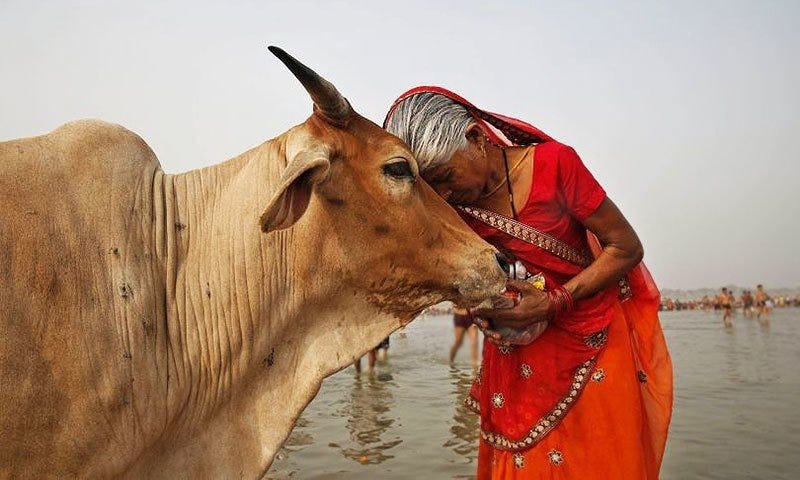
In Hinduism, cows are considered sacred. It is believed that all hardships can be alleviated through the worship of the cow, as it is considered to host 33 crore deities within. Serving the cow pleases all deities, bringing prosperity, happiness, and good health to the family. Cow committees petitioned for sensitivity towards cows. The question arises whether the cow is an essential economic asset, as these animals act as farm labor, fertilize the soil, and provide milk for consumption.
Religion protection encompasses not just one religion but eternal truth; it is a natural religion where everything follows its course. The present requires protection and safeguarding of religion, as it permeates society. Consequently, society necessitates protection and security.
The Sanskrit phrase "Dharma eva hato hanti, tasmaad dharmo na hantavyah" comes from Manusmriti, signifying that those who oppose religion are destroyed; those who support it are protected. This reflects not only adherence to religious customs but also divine rules of ethical duties and conduct. By standing for moral values, individuals are protected by the principles they uphold.
‘Nation protection’ goes beyond mere physical safeguarding; it embodies a deep spiritual, moral, and social upliftment imperative.
Definition of Nation: A nation signifies a shared identity, culture, and values.
Protecting dharma means adhering to necessary righteous practices appropriate to the current times. The essence of a guru teaches appropriate conduct in line with the times. Arjuna became dear to Guru Sri Krishna because he fought against the Kauravas to protect dharma. In summary, making efforts for the protection of dharma invites divine grace. Fulfilling duties truthfully is considered the supreme duty of a person. Speaking the truth should be considered paramount, and one should never lie, no matter the potential loss. Those who oppose dharma are destroyed; those who uphold dharma are protected. Therefore, to avoid negative consequences, one should never go against their dharma. Here, 'dharma' refers to a divine rule of moral duties and conduct.
‘Rashtra Raksha’ (Protection of the Nation) expresses a concept of responsibility towards the society and nation on both individual and collective levels. This extends beyond physical protection, indicating a profound need for spiritual, moral, and social upliftment.
Definition of a Nation: A nation is not just a physical structure (like mud, bricks, and stones). It symbolizes a shared identity, culture, and values. When people stop viewing their nation only from a materialistic perspective and understand its soul, the true spirit of nation protection awakens.
Nation protection is not merely about military or physical security; it involves the participation of all citizens, recognizing their inner strength, and their dedication. True nation protection is possible when every individual understands their role and becomes motivated to contribute positively to society. These feelings provide depth and inspiration, advancing not only individuals but also society and the nation.